Which newborn needs a blood test today?
NeoGold helps a nurse or community health worker answer that question with a phone photo and a printed color card. It is free, it runs with no internet, and it is being built in Bangladesh for the babies the existing tools were not validated on.
01The problem
Jaundice is common and usually harmless. The danger is the small share of babies whose bilirubin keeps rising and nobody notices in time.
It is very common
About 60% of term and 80% of preterm newborns develop jaundice. Most need nothing more than watching.
The severe cases are preventable
Severe jaundice can cause permanent brain injury (kernicterus) or death. Phototherapy started in time prevents almost all of it.
Babies arrive too late
At one Dhaka children's hospital, 20 of 61 newborns who needed an exchange transfusion already showed signs of kernicterus on arrival.
A health worker at a district clinic or on a home visit has two options today. She can look at the baby's skin, which is free but unreliable and harder on darker skin. Or she can send the family for a blood test, which costs them travel, time and money. The handheld meter that sits between those two options costs thousands of dollars, so it stays in the larger hospitals.
NeoGold is meant to sit in that gap: more reliable than looking, and cheap enough for the first point of contact.
02How a screening works
About a minute, on an ordinary Android phone, with the internet off.
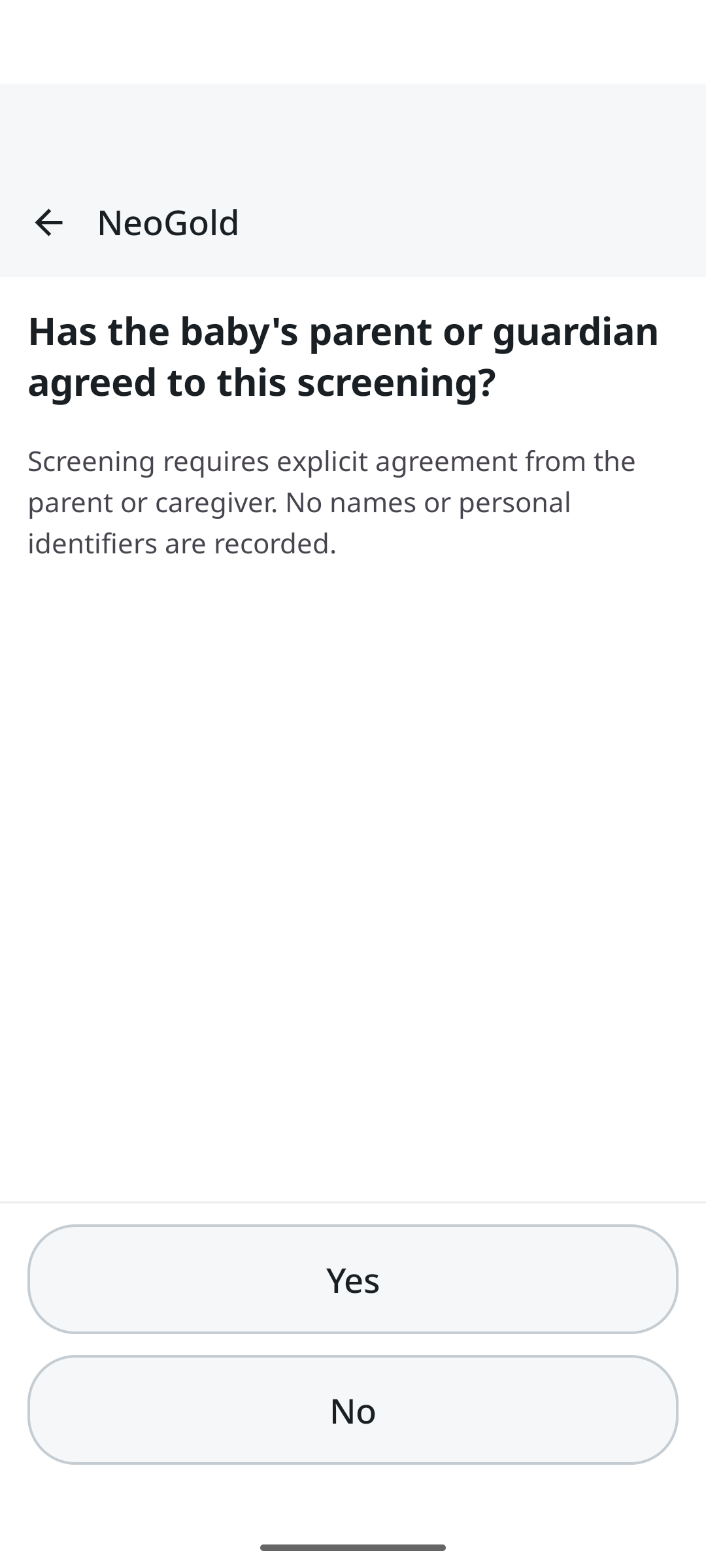
- The parent or guardian agreesThe health worker confirms consent in the app before anything else happens.
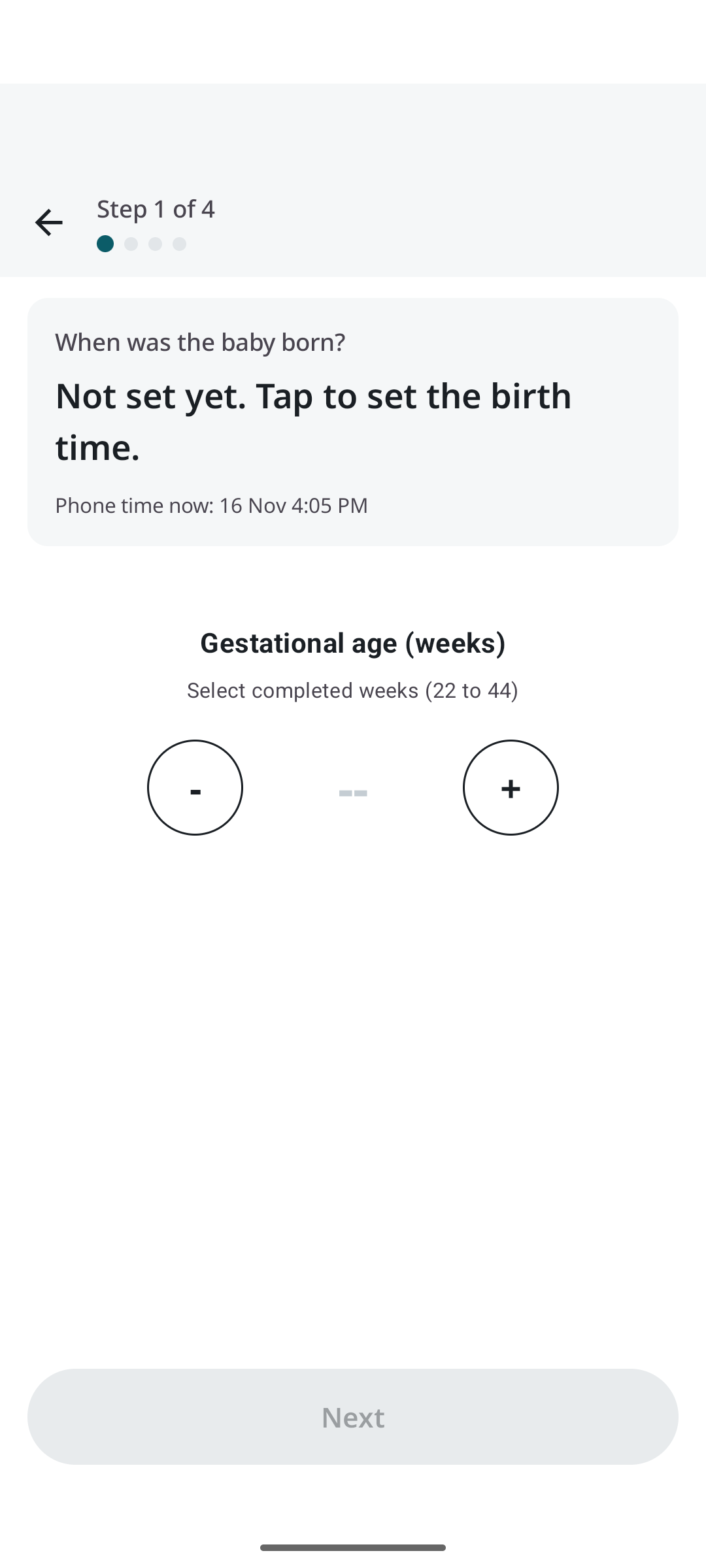
- She enters the baby's age and gestationAge is stored in hours. The app never asks for a name, a birth date or a phone number.
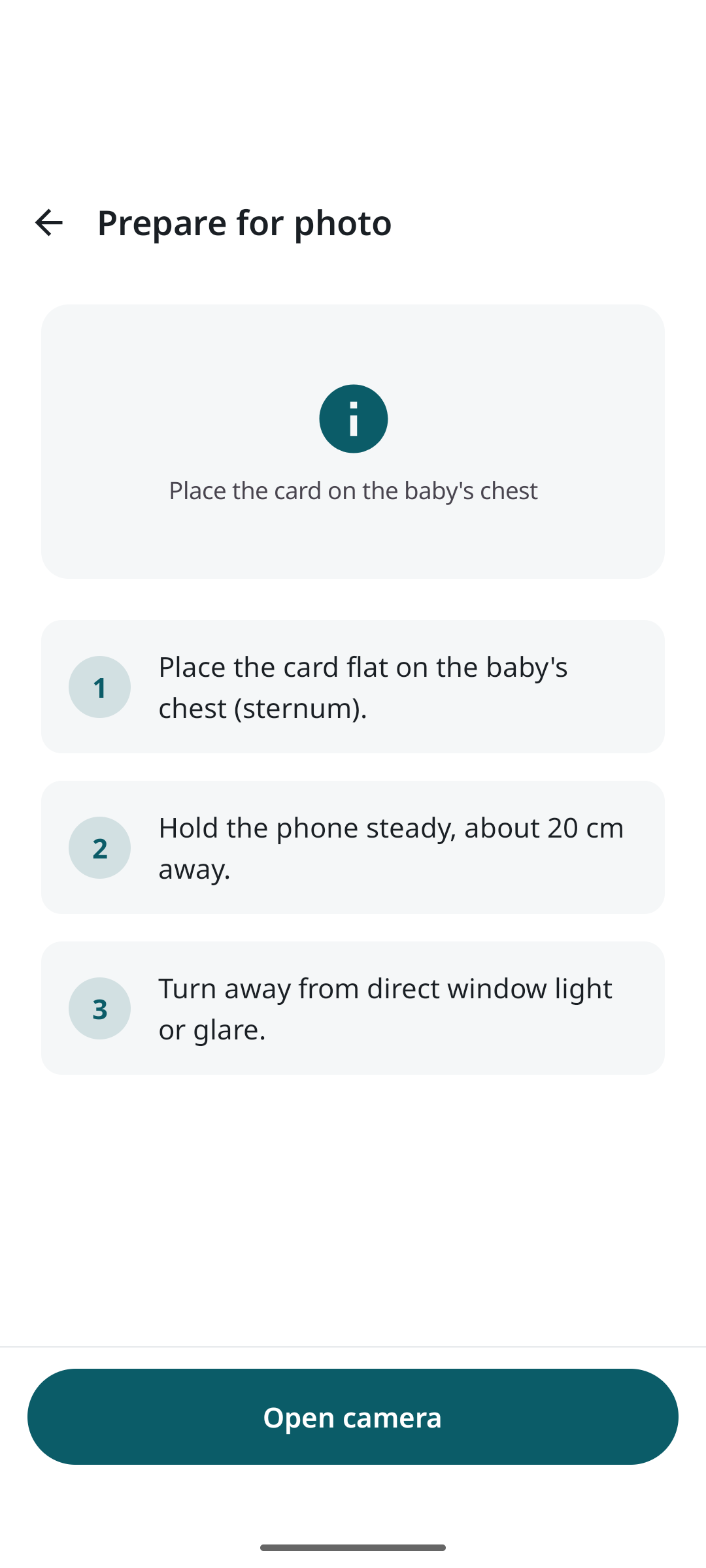
- She places the color card on the baby's chest and takes the photoThe app checks the light, the focus and the card before it accepts the picture. Uneven light blocks the camera until it is fixed.
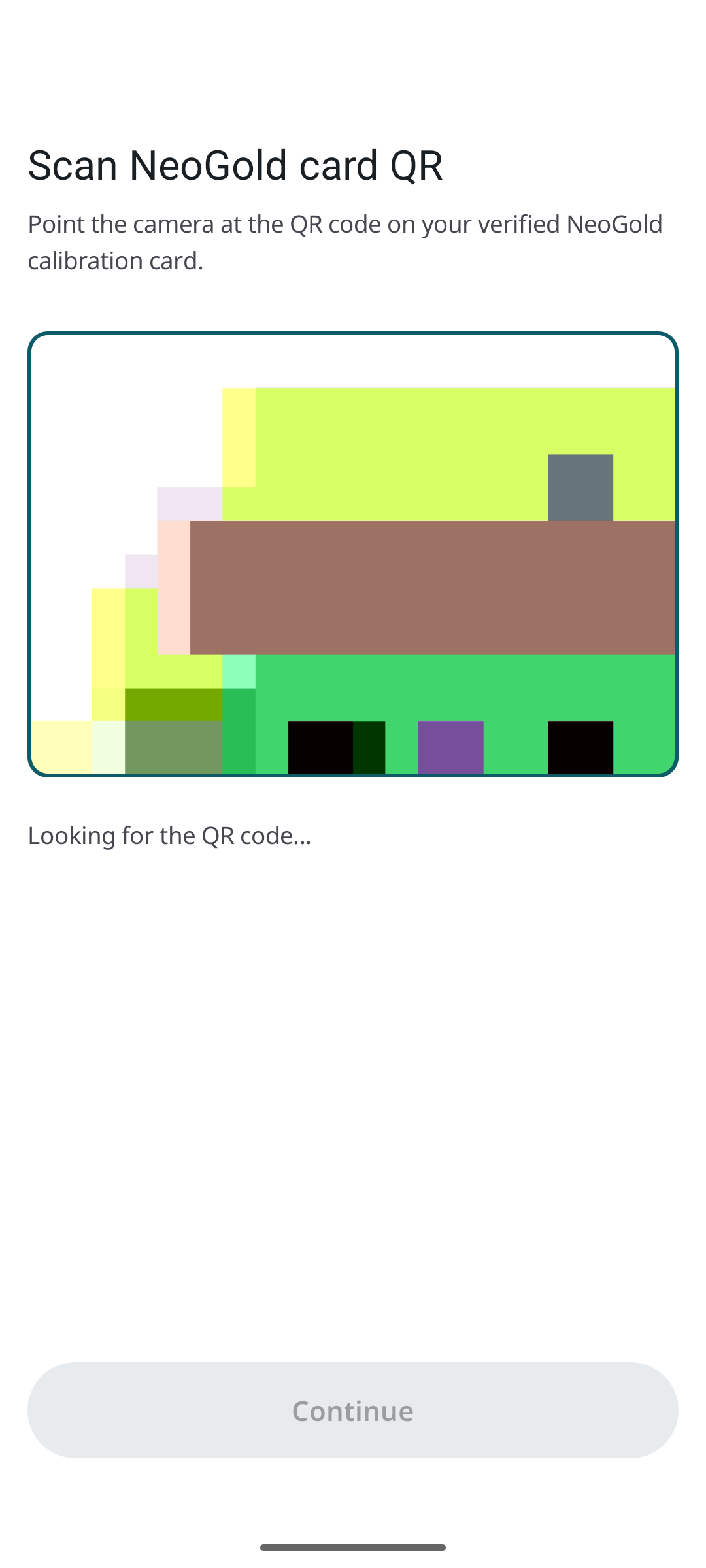
- The phone corrects the color and estimates riskThe card's known colors let the phone cancel out the lighting and the camera. A signed card and a signed clinical configuration must both check out first.
- The app suggests a next step, and she decidesThe suggestion is one of: refer for a blood test now, recheck within a set time, or routine care with warning signs. If the estimate is uncertain, the app says so and leans toward more care.
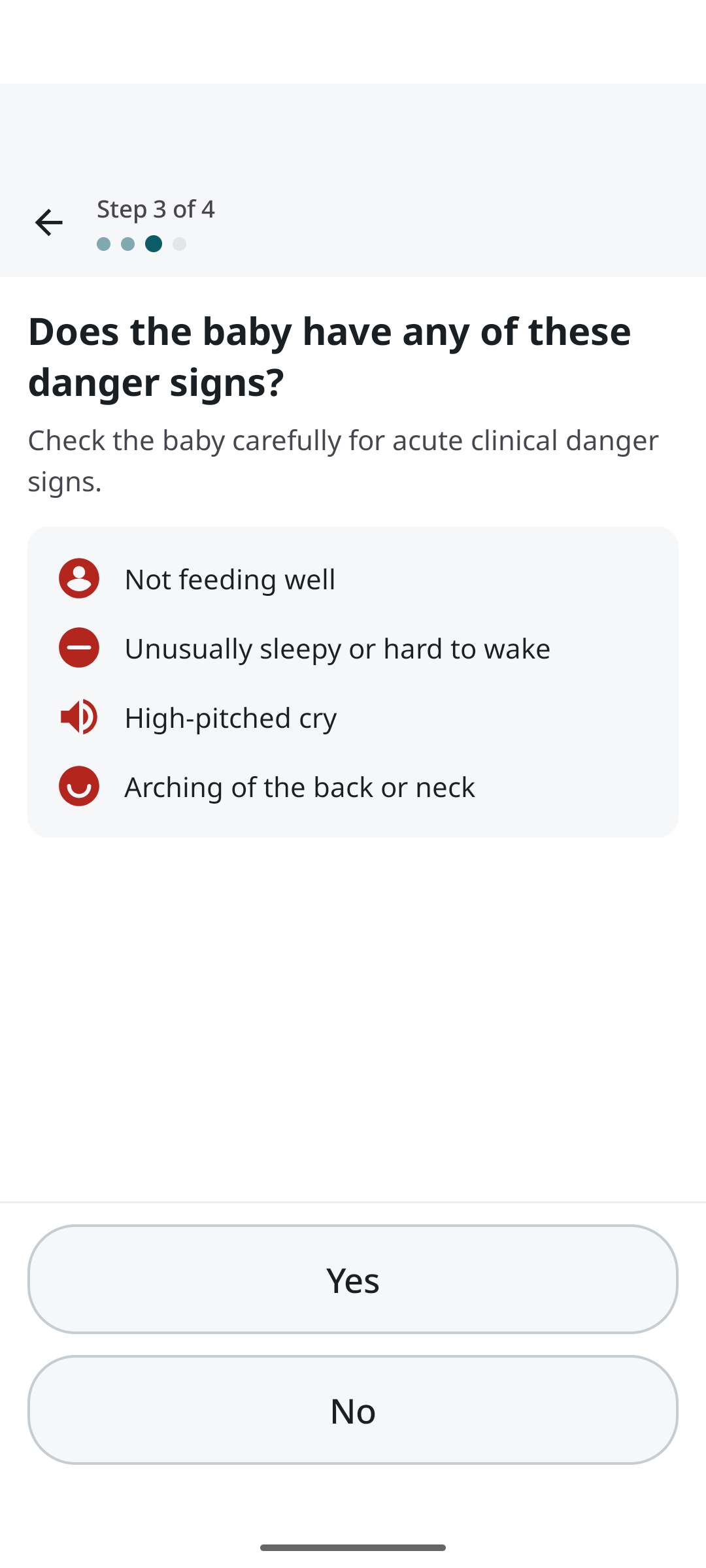
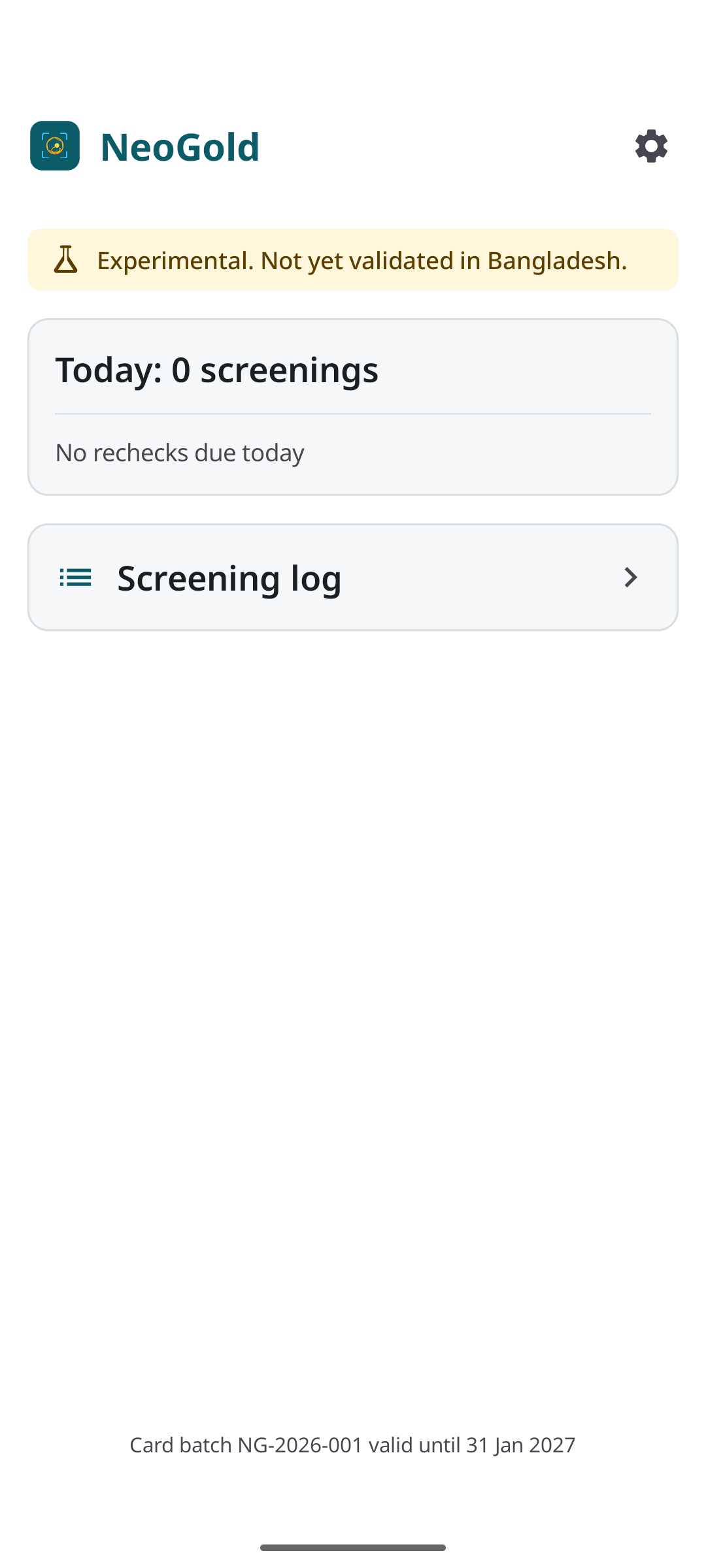
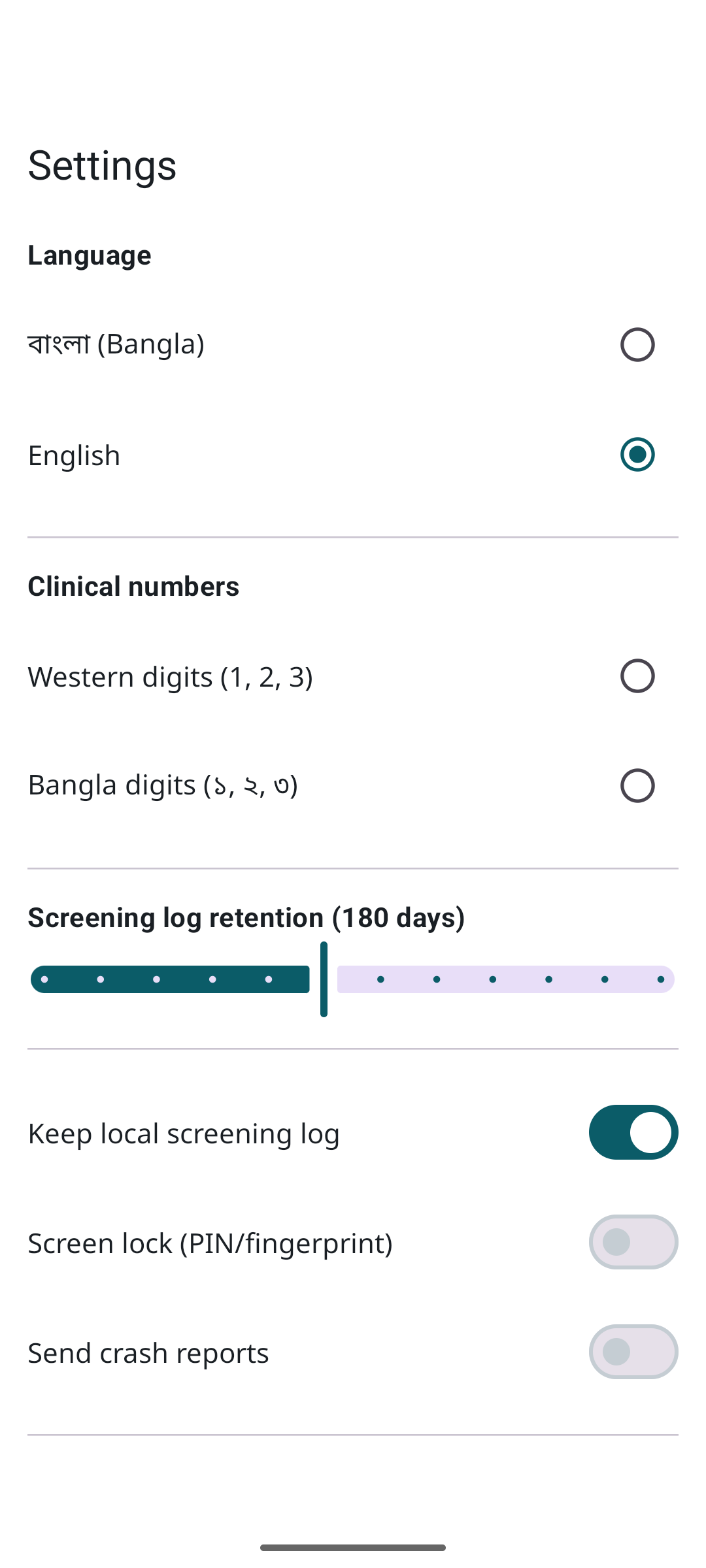
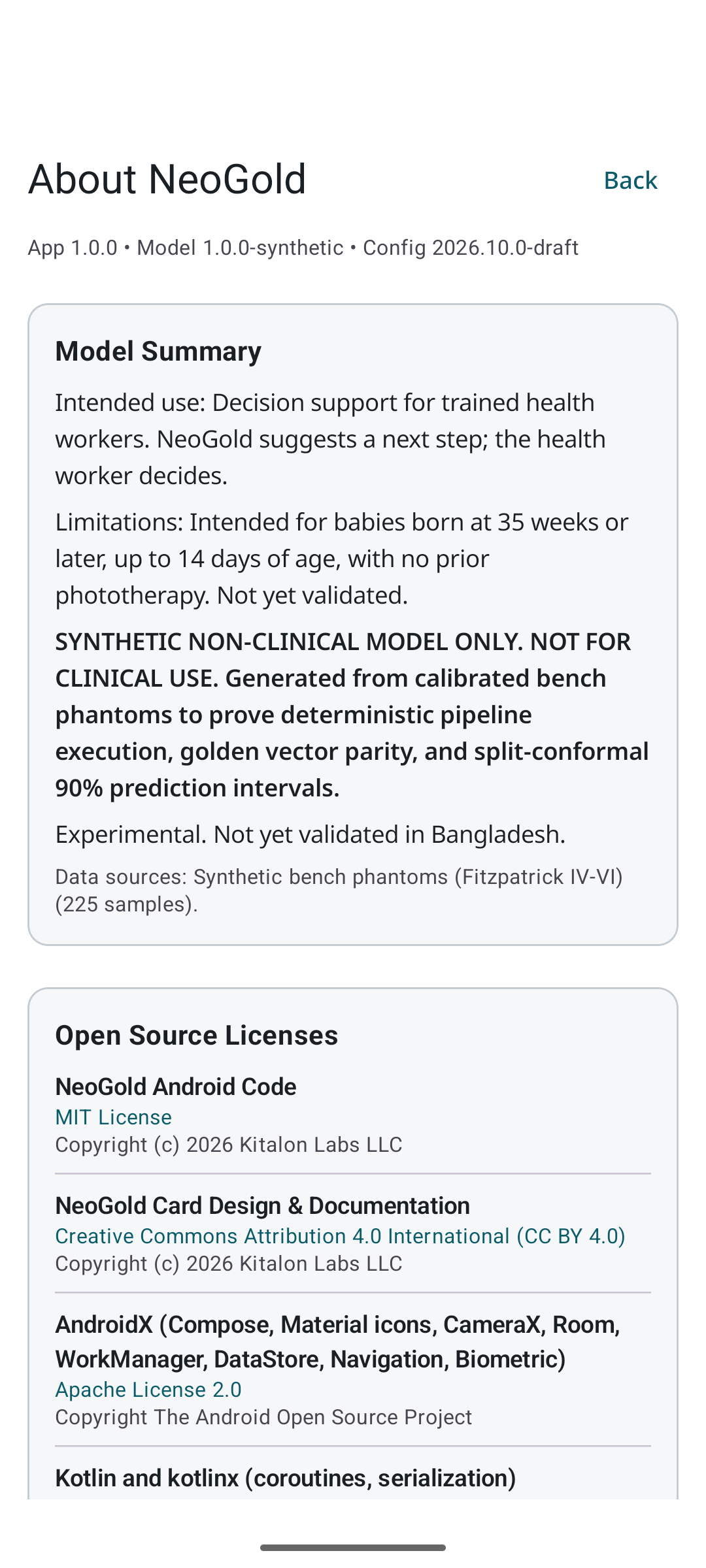
The screening workflow on a mobile screen
Screen captures from the NeoGold Android app (API 34). Designed for high outdoor legibility in rural clinics, one-handed operation, and immediate clinical triage before any image processing.
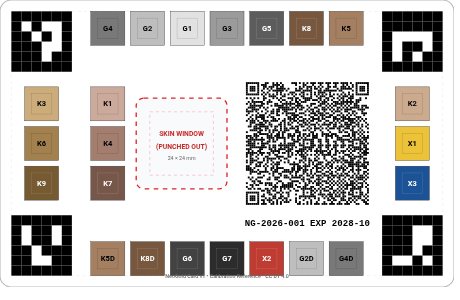 Card Specification · CC BY 4.0
The NeoGold Color Calibration Card
Camera sensors and clinic lighting vary across devices and rooms. NeoGold neutralizes lighting distortion by calibrating skin reflection directly against 24 verified spectrophotometry tiles in every frame.
03What existing tools leave open
Several research groups have shown that a phone photo can screen for severe jaundice. The science is not the gap. Access is.
| What a district clinic in Bangladesh needs | Published tools we reviewed | NeoGold |
|---|---|---|
| Works with no internet | Leading tools send the image to a server | Everything runs on the phone |
| Free to use | Commercial, or not publicly available | Free, no account, no ads |
| Code and method open to inspection | Closed | MIT code, open card spec, public docs |
| Validated on South Asian newborns | One CE mark covers lighter skin types; one major study excluded the darkest skin types | The goal of our validation study. Not done yet |
| Runs on low-cost Android phones | Restricted device lists or a single tested model | Android 8 and up, with a per-phone camera check |
| Bangla interface | None found | Bangla and English |
No tool we found meets all six. The combination is the point, and the references are listed under Sources.
04Safety and privacy by design
A screening tool for newborns has to be careful in ways an ordinary app does not.
It supports a decision. It does not make one.
NeoGold is decision support for trained health workers. It does not diagnose, and it never tells anyone a baby is fine.
When unsure, it chooses more care
Every rounding rule and every uncertain estimate pushes toward referral. Danger signs entered by the health worker override the photo entirely.
Clinical thresholds are signed, not coded
The numbers that drive the suggestion live in a configuration that a named clinical lead must sign. A build without that sign-off cannot show a result.
The screening flow stays hidden until validated
The current release is a closed research build. It collects study data and shows no result to the health worker.
No names, no cloud
Screening needs no account and stores no name, birth date, phone number or location. Screening photos are never written to storage.
Research data needs consent and stays local
Study uploads happen only with guardian consent, go only to the study's own server, and are encrypted on the phone until then.
Built for field security, zero cloud dependence
NeoGold runs entirely on-device. Health workers have full control over local audit logs, retention windows, and biometric access.
05Where it stands today
Plainly, including what is not done.
- DoneThe Android app runs end to end on a phone: consent, capture with quality checks, on-phone estimate, research mode, encrypted export.
- DoneThe study server, the signed card format and the release checks are built and public in the repository.
- DoneA first supervised field test at Good Health Hospital, Rangpur, with 20 children, led by pediatrician Dr. Zarin Tasnim. Her feedback on color distortion under fluorescent tubes led to the light check that now blocks the camera until lighting is even.
- Not yetClinical validation. NeoGold has no accuracy figures to report, and we will not quote any until a study with paired blood tests produces them.
- Not yetMeasured, print-verified color cards at study volume.
- Not yetA public release. That waits for validation results and a clinical sign-off.
What this means for a funder: the software risk is largely retired. The remaining risk is clinical, and it can only be answered with a properly run study. That is what the money is for.
06What funding pays for
The code was built without outside money. Three things cannot be: printed cards, test phones, and a clinical study.
| Level | What it unlocks | What you can check afterwards |
|---|---|---|
| Microgrant around US$1,000 | A first verified batch of color cards, a reference color chart and light box to measure them, and one or two low-cost test phones. | Card batch records and camera test results published in the repository. |
| Pilot US$5,000 to US$10,000 | The full set of test phones that covers the Bangladesh market, professional card measurement, ethics submission costs, and a small paired-data pilot at one hospital. | An ethics approval reference and a public pilot report. |
| Validation study US$25,000 and up | A multi-site study with paired blood bilirubin tests, a part-time study coordinator and clinical lead time, and an independent analysis. | A preprint with accuracy figures, the model card, and an openly licensed model. |
Grants are held by Kitalon Labs LLC. We publish what each grant paid for in the repository, next to the work it produced.
07Roadmap
- Now: closed research buildDistributed only to study phones through Google Play closed testing. Collects consented study data. Shows no result.
- Next: validation study in BangladeshPhotos paired with same-hour blood bilirubin, under ethics approval, across skin tones, phones and lighting.
- Then: publish the results, good or badAccuracy, limits and failure cases, with the trained model and the analysis code.
- Only after that: a public releaseWith signed clinical thresholds, a legal review, and training material for health workers in Bangla.
08Who is behind it
Kitalon Labs
A product studio based in Dhaka, Bangladesh. NeoGold is led by founder Sowad Al-Mughni, a product manager with over 14 years in software, including eight years working in Canada and the United States.
Clinical supervision
Dr. Zarin Tasnim, pediatrician, supervised the first field test in Rangpur. We are looking for a neonatology lead and a partner institution for the validation study.
NeoGold is not a business. There is no paywall, no subscription and no advertising, and there will not be.
09For researchers and deployers
Everything is inspectable
Requirements, architecture, the safety and privacy plan, 230 test cases and the model card are all in the public repository.
Built to be forked
Each study runs its own small server under its own data rules. Another country can adapt the language, the thresholds and the card under the open licenses.
We want clinical partners
If you run a neonatal unit, a community health program or a bilirubin study, we would like to hear from you.
| Part | License | Where |
|---|---|---|
| Android app, study server, tools | MIT | github.com/Kitalon-Labs-LLC/neogold |
| Color card design and specification | CC BY 4.0 | card/ in the repository |
| Documentation | CC BY 4.0 | docs/ in the repository |
10Questions
Is NeoGold a medical device?
Not today. The current build is a research tool that shows no result. NeoGold is designed as decision support, where the health worker decides. Any public release will follow validation and a legal review of what the rules in Bangladesh require.
How accurate is it?
We do not know yet, and we will not guess. Published research on similar methods reports sensitivity between about 85% and 100% for severe jaundice. NeoGold has to earn its own numbers in its own study.
Does it work on darker skin?
That is the question the project exists to answer. The card-based color correction and the study design target the skin tones that earlier tools left out. Until the study reports, treat it as unproven.
Why open source?
A tool that influences care for newborns should be open to inspection. It also lets a hospital or ministry in another country adapt it without asking permission or paying a fee.
What data does it collect?
In screening, none that identifies anyone, and nothing leaves the phone. In a study, only what the approved protocol and the guardian's consent allow, sent to that study's server.
Can parents use it at home?
No. It is built for trained health workers. Home use carries more risk and is out of scope.
How can I help?
Fund a stage above, introduce a clinical partner, review the code or the safety plan, or share this page with someone who works in newborn care.
11Sources
- Jaundice prevalence in term and preterm newborns; CE-marked smartphone screening: JMIR Pediatrics and Parenting, 2023
- Estimated deaths per year and sclera-based screening in Ghana: Outlaw, UCL doctoral thesis, 2021
- Exchange transfusion outcomes, Dr. MR Khan Shishu Hospital, Dhaka: Dhaka Shishu Hospital Journal
- Neonatal jaundice outcomes, Khulna Medical College Hospital: PubMed Central
- BiliCam validation in 530 newborns: Pediatrics, 2017
- Handheld meter cost estimate: MDedge
- CE certification scope by skin type: CORDIS, European Commission
- Skin type exclusions in a 2024 smartphone study: JournalFeed summary of JAMA Network Open
- Community health worker jaundice screening in Bangladesh: Gates Open Research